

A lady reader (Aarti) asked a genuine question in the newly created Contact section of Stable Investor.
“I don’t understand stock markets, but wait eagerly to read other articles on your website. Everywhere on your site, you advocate that one should make an Emergency Fund. As a novice, how should I start making this emergency fund?
“I don’t understand stock markets, but wait eagerly to read other articles on your website. Everywhere on your site, you advocate that one should make an Emergency Fund. As a novice, how should I start making this emergency fund?
I feel its very tough for me to save money. And every month end, I am almost broke. Please help.”
In this post, I would try to help the lady create an Emergency Fund in 5 easy steps.

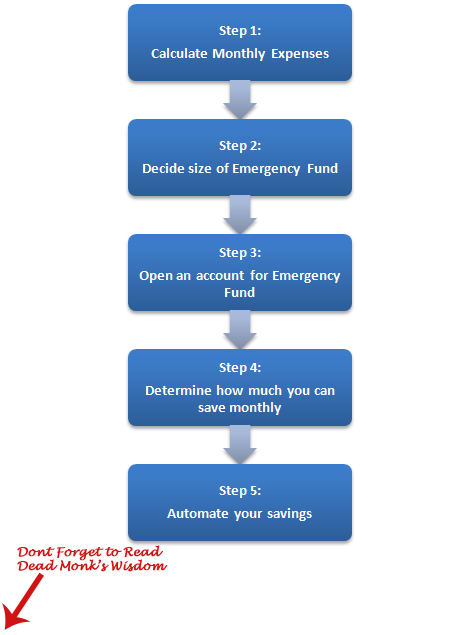
You can take following approach to create your own emergency fund –
Dead Monk’s Advice: Don’t risk your emergency fund by going after higher returns.
Many of your ‘well-wishers’ and so called financial experts will tell you that you can easily earn more than 7% if you are ready to invest in MFs, stocks etc. But beware. Do not listen to them.
Why?
Read the following scenario…
As of now, you might feel that you are not in some kind of emergency situation…

In this post, I would try to help the lady create an Emergency Fund in 5 easy steps.

Emergency Fund, as the name suggests is there to handle emergencies. A job loss, illness, accidents, etc. An emergency fund should have sufficient funds to cover your expenses in case you loose your job, meet with an accident or have some unplanned expenditures?
 |
| Remember God in good times and Emergency Funds in bad times |
You can take following approach to create your own emergency fund –
Step 1: Calculate your total monthly expenses
This is the first step and you should not get this one wrong. When calculating expenses, it is necessary to calculate your family’s expenses and not just your own. This should include everything from expenditure related to food, rent, loan repayments (EMIs), transportation (fuel) costs, monthly insurance premiums, monthly investments (SIPs in mutual funds), medicines, telephone bills, electricity & water bills to more discrete expenditures like eating outs, gifts, festivals etc.
Step 2: Decide how much you would like to save
This totally depends on your level of comfort. There are different opinions about how much money you should put in an emergency fund: 3 months, 6 months or 12 months worth of expenditures. But don’t worry about others. Its your emergency fund and only opinion which matters is yours. Ask yourself how much you would need to feel secure, and make that your target for an emergency fund.
Step 3: Open an account
Once you have decided how much you need to put in your emergency fund, it is time to decide where to keep your money. One major requirement of emergency funds is liquidity. This means that you cannot park your money in mutual funds, stock markets, gold or other illiquid assets. The best option would be to open a Savings Account. You should open an account exclusively for this emergency fund. Or otherwise, you would be tempted to dig into your emergency fund account for non-emergency requirements. Though saving accounts don’t offer much as interest, it is important to understand that what they do offer is ‘liquidity’. Some banks offer close to 6-7% on Savings Account, which is quite decent considering the liquidity these savings account offers.
Step 4: Determine how much you can save regularly
Emergency funds aren’t built in a day. It takes time and regular savings on your part. Analyze your finances and determine how much you can afford to put towards your emergency fund every month. Don’t worry if you start small. Even a small amount will do as when you start saving, you realize the importance of such a fund and the risk of not having such a fund.
Step 5: Automate it
If possible, make arrangements to allow automatic transfer of funds to this emergency account. This can be done on a pre-selected date every month. This is advisable as it brings discipline in saving and also prevents you from making any rash expenditure as you would always have the thought of automatic-emergency-fund transfer at the back of your mind. 🙂
And it is my personal experience that if you don’t have to think about it, savings are much easier.
And it is my personal experience that if you don’t have to think about it, savings are much easier.

Dead Monk’s Advice: Don’t risk your emergency fund by going after higher returns.
Many of your ‘well-wishers’ and so called financial experts will tell you that you can easily earn more than 7% if you are ready to invest in MFs, stocks etc. But beware. Do not listen to them.
Why?
Read the following scenario…
A little common sense would tell you that one should not take risks with emergency funds. Suppose you invest you emergency fund in stock markets. During recession, you lose your job. It is common knowledge that during recession (when you lose your job), the markets would be down, i.e. your investment would be quoting at prices lower than your purchase price. Hence, you would have to book loses in case you want to use your emergency fund. This would not have happened if you had stuck to safer savings bank account.
As of now, you might feel that you are not in some kind of emergency situation…

Suppose you earn Rs 50,000 every month. Your monthly expenditures are Rs 25,000. You want to build an Emergency Fund of 6 months, i.e. (6 Months x Rs 25,000 = Rs 1,50,000). Assuming, you are able to put away Rs 10,000 every month, it would take you 15 months to create an adequate emergency fund.
 |
| Timeline for creating an Emergency Fund – (Click To Enlarge) |
So start now as 15 months is a long time and you would not like to face an emergency without having a fund to handle it, isn’t it?